Can I charge my car in a socket?
Yes, technically. The cable in your boot plugs straight into a household socket, and in 2018 more than half of Norwegian electric car owners charged exactly that way. Since 2023, installing a socket as a charging point is no longer permitted in Norway. The reason is simple: fire safety.

Can you charge an electric car from a normal socket?
Technically, yes. The cable supplied with the car plugs straight into a regular household socket and will put energy in the battery. As an emergency measure, that is fine. As a daily routine, it is a bad idea, and in Norway it is no longer even a permitted option for new installations.
The problem is not the plug fitting. It is the load. Charging draws around 10 A, roughly 2.3 kW, continuously for eight hours or more. A kettle draws more than that, but for three minutes. A domestic socket and the wiring behind it are rated for short peaks and modest sustained loads, not for running near their limit through the night, every night. Heat builds up at worn contacts and in old cables, and heat is how electrical fires start.
Norwegian insurers have made the same point commercially: routine charging from an ordinary socket on an installation that does not meet the requirements can reduce a payout if something does go wrong.
What is a granny charger?
The cable in your boot goes by many names: granny charger, emergency charger, trickle charger, three-pin charger in the UK, occasional-use cable in the manuals. Formally it is a Mode 2 cable. The box in the middle limits the current, commonly to somewhere between 8 A and 10 A, and provides basic fault protection.
It exists for exactly one job: charging when nothing better is available. The Norwegian safety authority DSB puts it plainly: sporadic charging from an earthed socket when visiting or travelling is acceptable if no suitable alternative exists. That is the intended use. A holiday cottage once a summer, a relative’s driveway, an empty battery and no charger in sight. Not the same tired garage socket every night of the working week.
Plug-in hybrids deserve a mention here, because their smaller batteries make socket charging look harmless. A PHEV finishes in a few hours rather than overnight, which shortens the exposure, but the socket and the wiring behind it are the same. The same rules apply.

Why sockets and electric cars are a poor long-term match
Domestic sockets were designed, engineered and installed to power simpler things than cars. The rating on the socket assumes typical household behaviour: loads that come and go. An EV is the opposite, a single large load that sits at the same draw for hours. Add a socket that has seen fifteen years of vacuum cleaners, an outdoor socket that has seen fifteen winters, or wiring from a previous era, and the margin for error gets thin.
There is precedent for moving a load off the socket. Norwegian regulations pushed water heaters onto fixed wiring years ago for exactly the same reason: a large, long-running load on a general-purpose socket causes heat, and occasionally fires. Electric cars are simply the latest appliance to outgrow the plug.
Norway acted on it. In 2018, more than half of Norwegian electric car owners charged from ordinary household sockets. With NEK 400:2022, the installation standard removed the socket as a permitted option for new charging points; the standard took effect in July 2022 and became binding for new installations from January 2023. It is not retroactive, so a dedicated charging socket installed to the earlier standard, with the required type B residual current protection, may still be used. But no new ones.
Can I use an extension lead to charge my car?
No. Ordinary extension leads and cable reels are not rated for hours at 10 A, and a coiled cable traps its own heat. Manufacturers say the same in the manual. If a genuine emergency leaves no alternative, use a single heavy-duty lead rated well above the load, fully uncoiled, kept dry, never daisy-chained, and treat it as a one-off rather than a habit.
How slow is socket charging?
Slow. At 2.3 kW you add roughly 11 km of range per hour, and filling a 60 kWh battery from near empty takes around 26 hours. A dedicated home charger does the same job three to ten times faster. Our guide to how many amps an EV charger uses covers what your home connection can deliver, and our article on night charging covers when to do it.
What to use instead
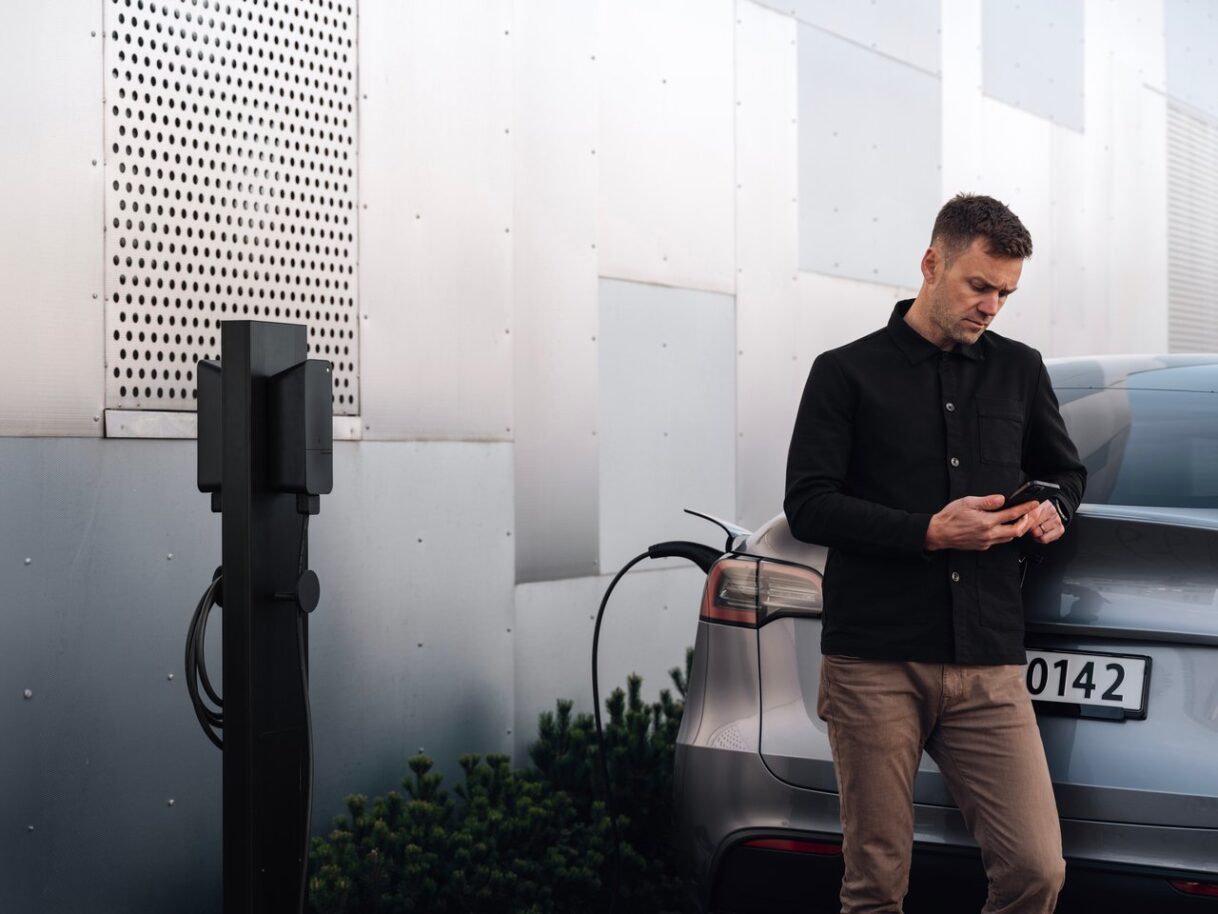
A dedicated Mode 3 charger, on its own circuit, is the answer everywhere in Europe. It is built for continuous load, includes residual current and DC fault protection, monitors itself while you sleep, and charges at 7.4 kW to 22 kW instead of 2.3 kW. A charger like the amina C also adjusts between 6 A and 32 A on its own, so the car takes what the house can spare rather than what the fuse will tolerate.
The cable in the boot still earns its place there. Just keep it for the day it is genuinely needed.
Related