Right-to-Plug Austria: Installing a Wallbox in an Eigentumswohnung Under WEG-Novelle 2022 (2026)
Right-to-Plug is the informal name for the changes the WEG-Novelle 2022 brought to §16 Abs. 2 of the Wohnungseigentumsgesetz, effective 1 January 2022.

What is the Austrian Right-to-Plug, and does it really apply to me?
The legal mechanism is called Zustimmungsfiktion – “deemed consent”. If a Wohnungseigentümer wants to install a slow charging point at their Kfz-Abstellplatz, they no longer need every other owner’s active sign-off.
They notify the Eigentümergemeinschaft in writing, the notice has to be posted visibly in the building, and the other owners have a two-month window to object. If no objection comes, consent is deemed to have been given, and the installation can proceed.
That is the Right-to-Plug in one paragraph. It applies only to Wohnungseigentum – that is, owned apartments. It does not extend in the same form to renters, where the Mietrechtsgesetz still requires the landlord’s active consent (more on that below).
The catch – and it is a significant catch – is what counts as “slow”. The Zustimmungsfiktion only applies to a single charging point with a maximum output of 3.7 kW single-phase or 5.5 kW three-phase. Above that threshold, you are back to the pre-2022 regime: active consent from every other Wohnungseigentümer, or a court order substituting that consent.
5.5 kW three-phase is roughly an 8-amp draw. It works for plug-in hybrids and small EVs with modest battery packs. For a modern battery-electric car with a 70+ kWh pack, it means an empty-to-full charge of around 12 hours, which is fine for an overnight charge if you can plug in every night. It does not work as well if you share the parking spot with a partner’s second EV, if you do long-distance days back to back, or if you ever want to use the wallbox commercially – for billing employer-reimbursed Dienstwagen charging, for example.
This is the threshold that quietly defines the entire Austrian wallbox conversation. Almost every charger sold in Europe operates at 11 kW or 22 kW three-phase. The Zustimmungsfiktion does not cover any of them.
What if I want a wallbox above 5.5 kW?
You have three paths.
The first is the original procedure: get the active, written consent of every other Wohnungseigentümer. In a smaller building with eight or ten units, this is often achievable, particularly if the Hausverwaltung is helpful and you are willing to attend the next Eigentümerversammlung in person. In a 60-unit Wiener Altbau where two owners live abroad and one is in long-term care, it is materially harder.
The second is the gerichtliche Ersetzung der Zustimmung. If consent cannot be obtained, you can apply to the Bezirksgericht for an order substituting the missing consents. The court evaluates whether the installation is verkehrsüblich – broadly customary – or whether the applicant has a legitimate interest in installing it. Recent OGH case law has been favourable. A 2023 ruling found that even a 3.7 kW single-phase wallbox at an Eigentumswohnung Kfz-Abstellplatz is a privileged measure under §16 Abs. 2 Z 2 WEG. That precedent supports higher-power installations too, though it has to be argued. The procedure typically takes several months, requires a lawyer, and is not free.
The third is the E-Mobilitätsgemeinschaft.
What is an E-Mobilitätsgemeinschaft, and when does it make sense?
The E-Mobilitätsgemeinschaft is a construct the WEG-Novelle 2022 introduced specifically to handle the case where several owners want chargers simultaneously, but the Eigentümergemeinschaft as a whole is not ready to invest in a Gemeinschaftsanlage. Several individual charging points are grouped legally and technically into a single “community”, and the group as a whole can claim the Zustimmungsfiktion – even where each individual installation exceeds 5.5 kW – under §16 Abs. 2 Z 2 WEG.
The practical attraction is that the E-Mobilitätsgemeinschaft can share a single grid connection, a single Lastmanagement system, and a single billing arrangement. Power is allocated dynamically accross the community, so ten wallboxes nominally rated at 11 kW don’t all draw 11 kW at the same time and don’t trip the building’s main fuse. Costs for the shared infrastructure are split between participating owners; latecomers who want to join later can do so against a fair contribution to the original installation costs.
The catch this time is that you need accurate metering at each charging point. The community shares one grid connection, but each owner pays only for the kilowatt-hours their car actually consumed. That only works if the meter inside each charger is precise enough – and accepted as such – for legally valid billing. Which brings us to the second piece of the 2026 puzzle.
Above 5.5 kW three-phase, the Zustimmungsfiktion stops covering you. Below 5.5 kW, most modern EVs charge too slowly to be useful. The E-Mobilitätsgemeinschaft is how those two facts get reconciled in practice.
Why does the Maß- und Eichgesetz matter for a wallbox?
The Maß- und Eichgesetz (MEG) is the Austrian framework that governs measurement accuracy in any commercial transaction where the measured quantity determines the price paid. A scale at the cheese counter, a fuel pump, an electricity meter in your apartment – all of them fall under MEG, and all of them have to be calibrated and re-calibrated on a defined schedule.
Until recently, the application of MEG to private home wallboxen was ambiguous. If you charged your own car at your own home with your own electricity, the meter inside the charger was for information only, and MEG did not really enter the conversation. As soon as the same charger is used by more than one person, or to bill another party (an employer reimbursing a Dienstwagen, a renter sub-billing electricity, an E-Mobilitätsgemeinschaft splitting a shared connection), the legal picture changes.
The Bundesamt für Eich- und Vermessungswesen (BEV) published its Eichvorschriften für Ladetarifgeräte in late 2023. These rules set out the technical and procedural requirements for chargers used in commercial billing contexts. The Arbeitsgemeinschaft Mess- und Eichwesen (AGME) followed up with an Infoblatt dated 9 January 2026 clarifying how the rules apply to employer reimbursement of home Dienstwagen charging.
The summary, in plain terms: if the charging session is being billed per kilowatt-hour, the measurement device has to satisfy MEG. A permanently installed wallbox with a conformity-assessed meter (typically a MID-certified meter – Measuring Instruments Directive 2014/32/EU) can satisfy this requirement, provided the meter measures only the energy delivered to the vehicle. A mobile charging cable with a built-in MID meter is explicitly not sufficient.
For the existing fleet of installed wallboxes, BEV operates a transition timeline. Chargers with a MID-certified meter that are already in use can be first-calibrated by an authorised Eichstelle through 31 December 2025, with re-calibration possible untill 31 December 2036. From 1 January 2037, only chargers with full ME-Zähler (full Mess- und Eichrecht conformity, equivalent to the German Eichrechtskonformität standard) will be valid for multi-user commercial billing.
Practically, this means a wallbox installed today with a built-in MID meter has a clear runway, but a wallbox without any conformity-assessed meter is already on the wrong side of the line if it’s used for any kind of billed charging.
Does this mean I’m forced to install an MID-certified wallbox?
Only in specific scenarios. The list of cases where the calibrated meter is genuinely required is narrower than some hardware vendors suggest. It comes down to who is paying for the electricity, and whether that payment is based on measured kilowatt-hours.
If you own your home, charge your own car, and pay your own electricity bill, you do not need an MID-certified wallbox. The meter inside the charger is for your own awareness only.
If you charge a Firmen-PKW at home and your employer reimburses you per kWh, you do need a measurement chain that satisfies MEG. The cleanest way to provide that is a wallbox with an integrated MID-certified meter. Some advisers argue that the cumulative kWh counter built into a non-certified wallbox, combined with software-side plausibility checks, is enough for the BMF’s “plausible Zuordnung der Lademenge” standard. That position exists, but it has not been tested in a Finanzamt audit at scale yet. The safer interpretation, and the one the AGME Infoblatt supports, is that a conformity-assessed meter is the path of least friction.
If you are part of an E-Mobilitätsgemeinschaft and the community bills individual members for their share of the shared connection’s electricity, you need MEG-compliant metering at each charging point. Same principle.
If you are a renter and your landlord is billing you separately for the electricity used at a wallbox in the shared garage, MEG applies.
The pattern is consistent. The cheaper a wallbox, the more likely it is to lack a properly certified meter, which is fine for the homeowner who only ever charges their own car and pays their own bill. For anything else – and almost every shared, employer-reimbursed, or rented context counts as “anything else” – a wallbox with an MID-certified meter built in is the path that stays out of trouble.
Read more about MID certified chargers

What changed for company cars on 1 January 2026?
This is the change with the most immediate impact on day-to-day life for Austrian drivers, and it is the one most people learn about by surprise when they look at their first 2026 payslip.
Until 31 December 2025, an employer could reimburse home charging of a Dienstwagen with a flat €30 per month per employee, tax-free, regardless of how much electricity was actually used. It was a simplification – popular with payroll departments, slightly inaccurate, but workable. From 1 January 2026, that flat rate is gone.
The BMF now requires that home charging of a Firmen-Elektroauto be measured per kilowatt-hour, attributed to the specific vehicle, and reimbursed at no more than the amtlicher Strompreis.
For 2026, the amtlicher Strompreis is set at 32.806 cents per kWh. This is a slight reduction from the 2025 value and is reset each year by the Finanzministerium. An employer can reimburse less than this rate but not more; any excess is treated as ordinary, taxable Arbeitslohn and is subject to social insurance contributions and Lohnsteuer.
The 0% Sachbezug for fully electric company cars survives. CO₂ emissions of zero grams per kilometre still mean no benefit-in-kind on the vehicle itself, which is the single largest tax advantage of an EV company car in Austria. The reform affects the electricity reimbursement, not the car.
The technical requirements for the reimbursement to qualify as tax-free are specific. The kWh delivered to the company car must be separately measured and identifiable – typically through a wallbox with RFID authentication, a back-office that records each session against the company-car’s unique identifier, or a vehicle-side logging system. A shared household wallbox where the company car and a partner’s private EV both plug in without distinction does not satisfy the requirement, even if both cars are electric. The reimbursement has to be tied to a specific session on a specific vehicle, not to the household’s overall consumption.
Employers can also pay up to €2,000 tax-free toward the installation of a private wallbox at the employee’s home, provided the wallbox is being used to charge a Dienstwagen. That provision exists to take some of the sting out of the new measurement requirements: in practice, the cleanest way for an employer to ensure compliant reimbursement is to specify and pay for the wallbox themselves.
What does a compliant home Dienstwagen setup actually look like in 2026?
The mechanics are simpler than the regulations make them sound.
A permanently installed wallbox, ideally with a built-in MID-certified meter, is wired into the employee’s home electrical installation by a konzessionierter Elektrofachbetrieb. The installation has to comply with the relevant ÖVE/ÖNORM standards and is registered with the local Netzbetreiber. An annual recurring inspection is required where the wallbox is used for shared or commercial purposes.
The charger reports each session – start time, end time, kWh, and an authentication identifier – to a back-office over OCPP. The authentication is typically an RFID card carried by the driver of the Dienstwagen; charging sessions without that card are not flagged as reimbursable. The back-office produces a monthly export. The employer pays the employee at or below the 32.806 cent/kWh ceiling. The employee’s payslip handles the line; the Lohnkonto retains the supporting export in case the Finanzamt ever asks.
None of this is fundamentally different from the Belgian split-billing setup or the German Eichrecht-konform model, and most of the back-office platforms operating in DACH already handle Austrian payroll flows. The choice points for the employer are which wallbox brand, which back-office, and whether to centralise the reimbursement through a single CPMS or to leave it as a payroll line item per employee.
MID-certified EV charger for shared installations
Is there still a Wallbox subsidy in 2026?
This is the question with the least satisfying answer. The Austrian federal funding landscape for private Wallboxen has effectively closed for now.
The Bundesförderung for private wallboxes, administered through Umweltförderung, ran through to early 2026 and stopped accepting new registrations on 31 March 2026 once the budget was exhausted. The eRide programme for electric two-wheelers ended the same way, ahead of schedule. The klimaaktiv mobil framework, which had been the umbrella programme for several individual e-mobility supports, is paused; a re-launch in 2026 is described by the BMK as “possible if budget becomes available” but is not currently confirmed.
What remains is the regional layer. Several Bundesländer run their own Wallbox subsidies independently of the federal programme – Niederösterreich, Salzburg, Oberösterreich and Vorarlberg have all maintained some level of support at various points, though the specific amounts and eligibility windows shift more often than the federal programme did. A check on the current state of the Förderung in your own Bundesland – including any combination with a PV-Anlage or Speicher subsidy – is the practical first step before any purchase.
The Mobilitätsministerium has indicated that the focus of e-mobility spending in 2026 is shifting toward public (and especially fast) charging infrastructure, with around €500 million budgeted across 2025 and 2026 for the LADIN and similar programmes targeting commercial deployment. For private homeowners and Wohnungseigentümer, that does not directly help, but it does explain why the federal Wallbox-Förderung was allowed to lapse.
What if I rent?
The WEG-Novelle 2022 did not extend the Zustimmungsfiktion into the Mietrechtsgesetz. As a Mieter, you still need active written consent from the landlord (Vermieter) to install a wallbox at the rented Kfz-Abstellplatz. AustriaTech and other industry bodies have been calling for a Mietrecht equivalent of the Right-to-Plug for several years, but the legislative texts have not been adopted.
In practice, a few paths work. If the landlord is a private individual and the rented apartment includes a dedicated parking spot, a written agreement covering the installation, ownership of the hardware, and end-of-tenancy removal or transfer is usually acceptable. If the landlord is a gemeinnütziger Bauträger or a large institutional Vermieter, the situation is more variable – some have standard wallbox installation policies, others delegate the decision to the building’s Hausverwaltung.
For Dienstwagen drivers in particular, this is worth flagging in a car policy early in the lease cycle. A new employee who has just signed a 36-month rental contract and discovers their Vermieter is unwilling to permit a wallbox installation is a problem that’s easier to anticipate than to fix retroactively.
What about grid capacity in a Mehrparteienhaus?
For a single-family home with a dedicated grid connection and a 25-amp main fuse, an 11 kW three-phase wallbox is rarely a problem. The connection has plenty of headroom for a single charger drawing roughly 16 amps. The installation is straightforward and the Netzbetreiber registration is administrative rather than substantive.
For a Mehrparteienhaus with a shared Tiefgarage and a single building-level connection, capacity is the real bottleneck. A typical 60-unit Wiener Wohnhaus might have a 100-amp building-level connection serving lifts, lighting, ventilation, and the lobby. Adding even a handful of 11 kW wallboxen on that connection – each drawing 16 amps under load – can push the building toward its main fuse limit during the early evening, when several residents arrive home and plug in at the same time.
Two responses are common. The first is an upgrade of the building’s grid connection, which is technically straightforward but typically costs €15,000–60,000 depending on the local Netzbetreiber, the cable distance, and whether a new Trafostation is required. The cost is usually a collective Eigentümergemeinschaft expense, allocated by Nutzwert.
The second is dynamic Lastmanagement at the level of the charging infrastructure. A controller monitors the building’s baseload consumption in real time and modulates the power delivered to each charger to keep the total draw under the available capacity. Modern systems can scale down to as low as 6 amps per charger before pausing entirely, which means 15 to 20 chargers can frequently share a connection that a static calculation would say supports only 8 or 9. Where the building wants to avoid the Trafo upgrade and the Eigentümergemeinschaft can agree on a coordinated approach, Lastmanagement is the cheaper path.
It only works, however, if the chargers all speak a compatible protocol – wich in practice means OCPP – and if local control runs on the chargers themselves rather than depending on a single vendor’s cloud.
What technical features matter for an Austrian installation in 2026?
A handful of items distinguish a charger that will still be useful in five years from one that will need replacement well before that.
- An integrated MID-certified meter is the threshold check. Without it, the charger is not usable for any billed charging, and the BEV transition timeline means that gap will only get harder to work around as the 2037 ME-Zähler deadline approaches.
- OCPP support – genuine, vendor-independent OCPP 1.6 or 2.0.1, not OCPP routed through a proprietary cloud – is what keeps the charger compatible with whichever back-office the employer, Hausverwaltung, or E-Mobilitätsgemeinschaft prefers. The risk in “OCPP-compatible” chargers that depend on the manufacturer’s own platform is a soft lock-in: the charger nominally supports the open standard, but core features only work with the manufacturer’s back-office, so switching providers later requires hardware replacement.
- Local Lastmanagement – the ability to balance load across multiple chargers without depending on a continuous internet connection – matters more in Tiefgarage installations than in single-family homes, but it is the difference between an installation that survives an internet outage and one that trips the building fuse the first time the connection drops.
- RFID authentication is required in any reimbursed-charging context. A Dienstwagen driver needs to identify each session as belonging to the company car; an E-Mobilitätsgemeinschaft needs to attribute each session to the right Wohnungseigentümer. Without authentication, the metering data is not actionable for billing.
- FI-Schalter Typ A with built-in DC-Fehlerstromerkennung is the standard the ÖVE/ÖNORM requires for an AC wallbox installation. Chargers that bring DC fault detection on board reduce installation cost. A Typ B FI-Schalter externally would otherwise be required, at meaningful additional expense, and adds to the bill of materials.
- The other features – bidirectional charging, V2G, Plug & Charge over ISO 15118, dynamic spot-tariff integration – are useful where the rest of the ecosystem supports them. In Austria, that support is currently uneven. The BEÖ has been lobbying for a provider-neutral Plug & Charge framework but the legal basis is not yet in place. Where these features are on the roadmap rather than the requirements list, they are reasonable to value but not to over-pay for.
Does the Zustimmungsfiktion apply if the building has only Gemeinschaftsstellplätze?
Less straightforwardly. The Zustimmungsfiktion is structured around a Kfz-Abstellplatz that is the exclusive use of a single Wohnungseigentümer. Where parking is shared on a first-come basis, an individual Wohnungseigentümer typically does not have the legal standing to install a charger that would be physically located in common space. The Eigentümerversammlung route, or an E-Mobilitätsgemeinschaft involving multiple owners, is usually how this gets resolved.
If a neighbour objects within the two-month window, what happens?
The Zustimmungsfiktion does not apply. The installer can still proceed by obtaining the active consent of all other Wohnungseigentümer, or by applying to the Bezirksgericht for an order substituting the missing consents. The court will weigh whether the installation is verkehrsüblich or whether the applicant has an objectively legitimate interest. The hurdle is not high, but it is not automatic either.
Who pays for the installation?
The Wohnungseigentümer who initiates the installation. They cover the wallbox itself, the Zuleitung from the building’s main distribution to their Kfz-Abstellplatz, the Subzähler if required, the labour of the konzessionierter Elektrofachbetrieb, and any FI-Schalter or other safety hardware. They also bear the annual inspection cost where the installation is used for shared or commercial purposes. Other Wohnungseigentümer can later join under §16 Abs. 5 WEG, contributing a fair share of the original costs.
Can someone else later install a charger on the same Zuleitung?
Yes, and the law explicitly anticipates this. §16 Abs. 5 WEG gives later joiners a Teilhabeanspruch – a right to participate. The original installer cannot refuse, though the latecomer must pay an angemessener Ausgleich toward the original installation costs. This is one of the reasons coordinating early, before individual installations start happening, usually produces a better outcome than reacting after the fact.
What if my partner also has a Dienstwagen, and we charge on the same wallbox?
Each Dienstwagen needs its own RFID identifier so the charger can attribute each session to the correct vehicle and employer. The amina M and most other modern wallboxen support multiple authentication tokens out of the box. Where the two employers use different back-office platforms, the same physical wallbox can usually still serve both, provided the back-offices both support the wallbox’s OCPP profile. In a small minority of cases – typically where one employer uses a heavily proprietary platform – a second wallbox is the cleaner administrative answer.
Is a mobile charging cable with a built-in MID meter sufficient for Dienstwagen reimbursement?
No. The AGME Infoblatt of 9 January 2026 is explicit on this point: a MID-zertifizierter meter used in a mobile charging cable does not satisfy the Mess- und Eichgesetz for billed charging. The meter has to be in a permanently installed, fixed wallbox connected to the home grid at the Netzanschlusspunkt, measuring only the energy delivered to the vehicle.
What should I actually do next?
For a Wohnungseigentümer planning to install a single wallbox in 2026, the practical sequence is fairly predictable.
- Start by getting a written quote from a konzessionierter Elektrofachbetrieb that covers the wallbox itself, the Zuleitung, the FI-Schalter configuration, the Subzähler, and the registration with the local Netzbetreiber. The quote should specify whether the wallbox model has a built-in MID-zertifizierter meter, what its OCPP support looks like, and what kind of Lastmanagement it provides – this is the moment to ask the questions, not after the installation.
- Issue the notice under §16 Abs. 2 Z 2 WEG. The notice has to be visibly posted in the building, has to describe the planned installation clearly, has to mention the two-month objection window, and has to identify the Rechtsfolgen if no objection is raised. Most Hausverwaltungen have a template; if yours doesn’t, ÖAMTC and AustriaTech both publish reasonable starting points.
- If the planned installation is above 5.5 kW three-phase – which is almost always the case for an 11 kW or 22 kW wallbox — pair the notice with a conversation. Walk the other owners through what the installation involves, what it doesn’t involve (no impact on the shared Stromrechnung, no impact on the main fuse if Lastmanagement is configured correctly), and what it could mean for them later (the Teilhabeanspruch they would gain under §16 Abs. 5 WEG). In a small building, this conversation usually produces an active written consent within a week and removes the need for the Zustimmungsfiktion altogether.
- If the building is large enough that several owners are likely to want chargers, raise the E-Mobilitätsgemeinschaft option at the next Eigentümerversammlung. Coordinating early is meaningfully cheaper than retrofitting Lastmanagement across several incompatible chargers later.
- For Dienstwagen drivers specifically, talk to the employer’s fleet manager about the 2026 reimbursement framework before signing anything. The €2,000 tax-free Wallbox-Kostenersatz only applies if the employer is paying for the charger; the choice of model affects whether reimbursement runs smoothly or generates a Finanzamt question two years later. Most large Austrian employers have settled on a small number of approved wallbox models for Dienstwagen home installations — getting on that list is usually faster than negotiating an exception.
Want to know more about the amina M?
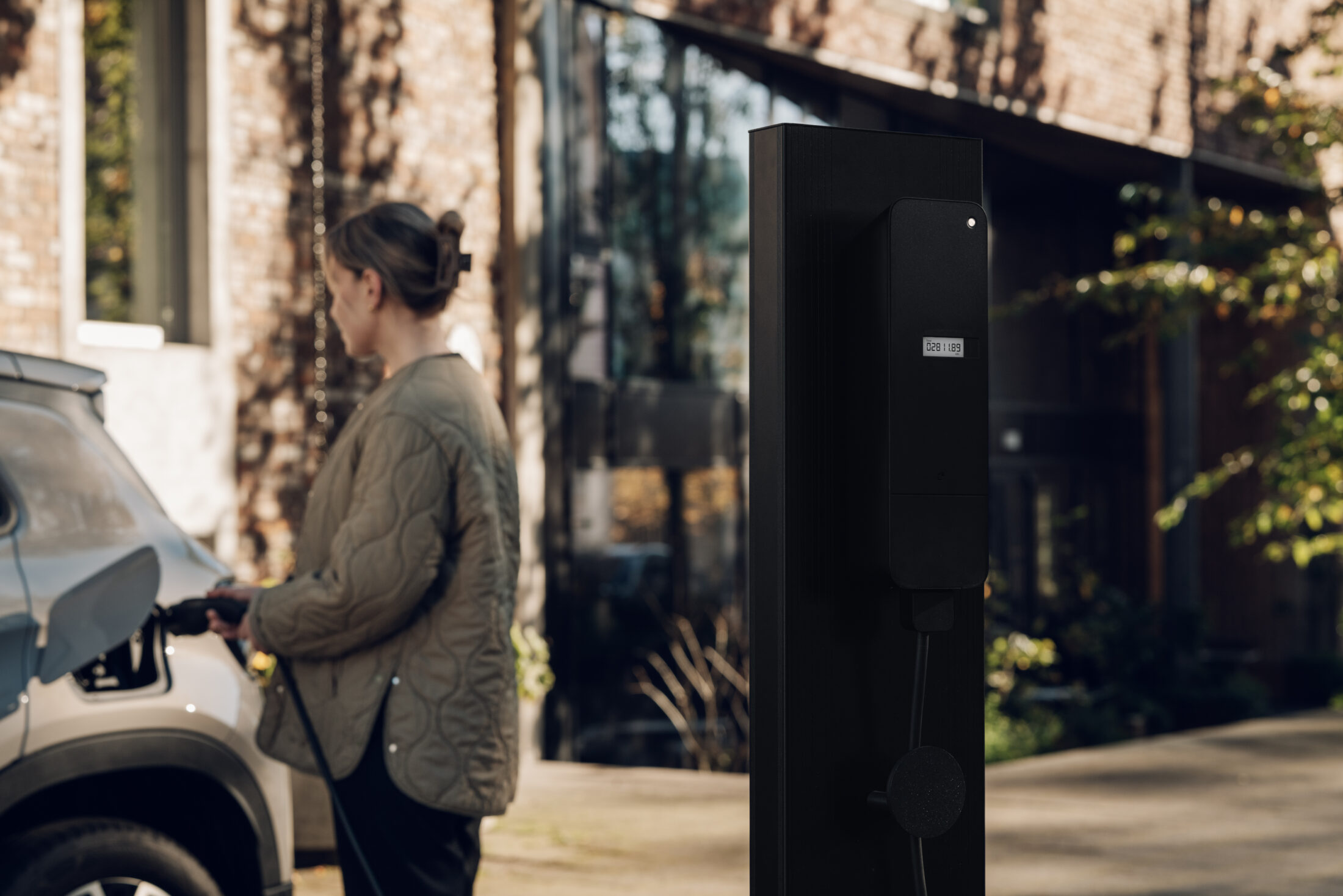
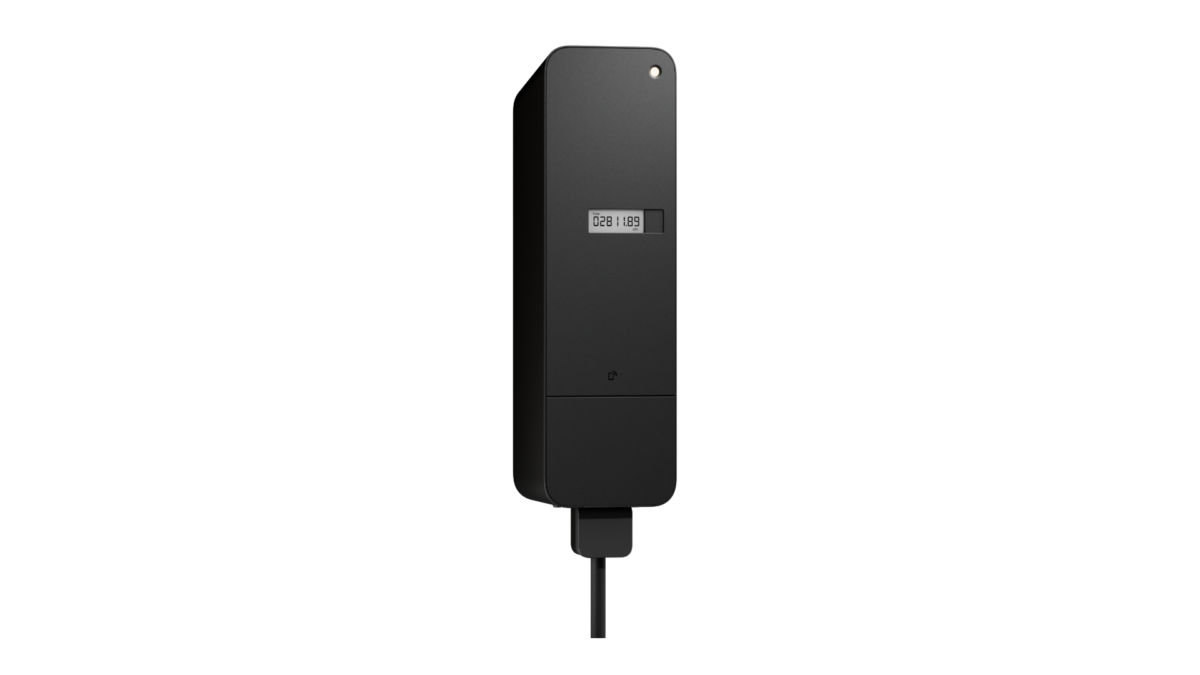
The amina M is a 1- and 3-phase AC wallbox built specifically for installations where measurement, billing, and back-office integration are non-negotiable: multi-unit residential, fleet and workplace charging, and home installations for reimbursed Dienstwagen. The MID-certified meter is integrated; OCPP 1.6 with full session reporting is built in; lokales Lastmanagement and RFID authentication ship as standard. Manufactured in Norway. IP54-rated. Pre-configured for installation by an Elektrofachbetrieb. For Austrian installations, the model satisfies the AGME requirements for tax-free Dienstwagen-Erstattung from 1 January 2026 and falls within the BEV Eichvorschriften timeline for multi-user billing through to 2036.
Essential resources
- Wohnungseigentumsgesetz §16: ris.bka.gv.at (full legal text, including the Zustimmungsfiktion mechanics)
- AGME Infoblatt – Rückerstattung Arbeitgeber/Arbeitnehmer E-Mobilität: Arbeitsgemeinschaft Mess- und Eichwesen, 9 January 2026 (the authoritative guidance on MEG for Dienstwagen home charging)
- BEV Eichvorschriften für Ladetarifgeräte: bev.gv.at (calibration rules and authorised Eichstellen)
- AustriaTech Right-to-Plug guide: austriatech.at (practical explanation of the WEG-Novelle 2022)
- ÖAMTC e-Mobility Check: oeamtc.at (installer-side guidance for Mehrparteienhäuser)
- BMF Sachbezugswerte 2026: bmf.gv.at (the current amtlicher Strompreis and Dienstwagen reimbursement rules)
- Klimaaktiv mobil Förderdatenbank: klimaaktiv.at (current status of national and regional e-mobility funding)
Related