Installing an EV charger at home: What you need to know
As more drivers make the switch to electric vehicles, the demand for EV charger installation at home has grown rapidly. Having your own charger means waking up to a fully charged car, lower running costs, and far less reliance on public charging points. This guide covers the essentials of home EV charger installation, from costs and installation steps to finding a certified installer.
Why fit a dedicated home charger?
Because it is cheaper, faster and safer than the alternative, and because in most of Europe it is now the only compliant way to charge at home. A dedicated charger runs on its own circuit, charges three to ten times faster than a household socket, and is built to run at full load overnight without complaint. Home electricity on the right tariff also costs a fraction of public charging. The reasons not to rely on a socket, and what the safety rules actually say, are in our guide to charging from a regular socket.
What you need before installing
Four things decide what you can fit and what it will cost. Knowing them before you call an installer saves time and a few awkward surprises.
Your supply. Single-phase or three-phase. Single-phase caps a home charger at 7.4 kW; three-phase opens up 11 kW and 22 kW. Most homes in the UK are single-phase, while three-phase is common in Norway, Germany and much of the continent.
Your available capacity. Your main fuse sets how much power the house can draw at once, and the charger has to share it with the oven, the hot water and everything else. This is why load balancing matters, and why a bigger charger is not always usable on a smaller supply. Our guide to how many amps an EV charger uses covers the sums from 6 A to 32 A.
A spare way in the fuse box. Every charger needs its own dedicated circuit. If the consumer unit is full, the installer may need to add a way, or occasionally do a small upgrade.
A certified installer. This is fixed electrical work, not a plug-in appliance, so professional installation is a legal requirement across most of Europe and mandatory in Norway. More on finding a good one below.
Choosing the right charger
Three things actually matter: power, connector, and how the charger is managed. The rest is preference.
Power. Home chargers come as 7.4 kW, 11 kW or 22 kW. For a single car charged overnight, 7.4 kW is plenty, adding enough range by morning to cover roughly ten times the average daily drive. The higher speeds need three-phase, and it is worth knowing that most electric cars accept a maximum of 11 kW on AC anyway, so a 22 kW charger often cannot be used in full. Our guide to charging speeds has the detail.
Connector. In Europe this is Type 2, which every modern EV and plug-in hybrid uses. A fixed, tethered cable is usually the tidiest option at home.
Management. This is where our own range splits by need. The amina S is the home unit: up to 22 kW, Zigbee and Bluetooth for smart-home integration, and at about a kilogram one of the lightest and most discreet chargers on the market. The amina C is the same hardware with OCPP added, for a shared car park, a managed setup, or anyone who wants their charger to work with any operator or energy platform rather than a single app. And where charging has to be billed to a certified standard, which is common in the Benelux countries, Finland, Germany and Austria, the amina M is the MID-certified option.
Working with a certified installer
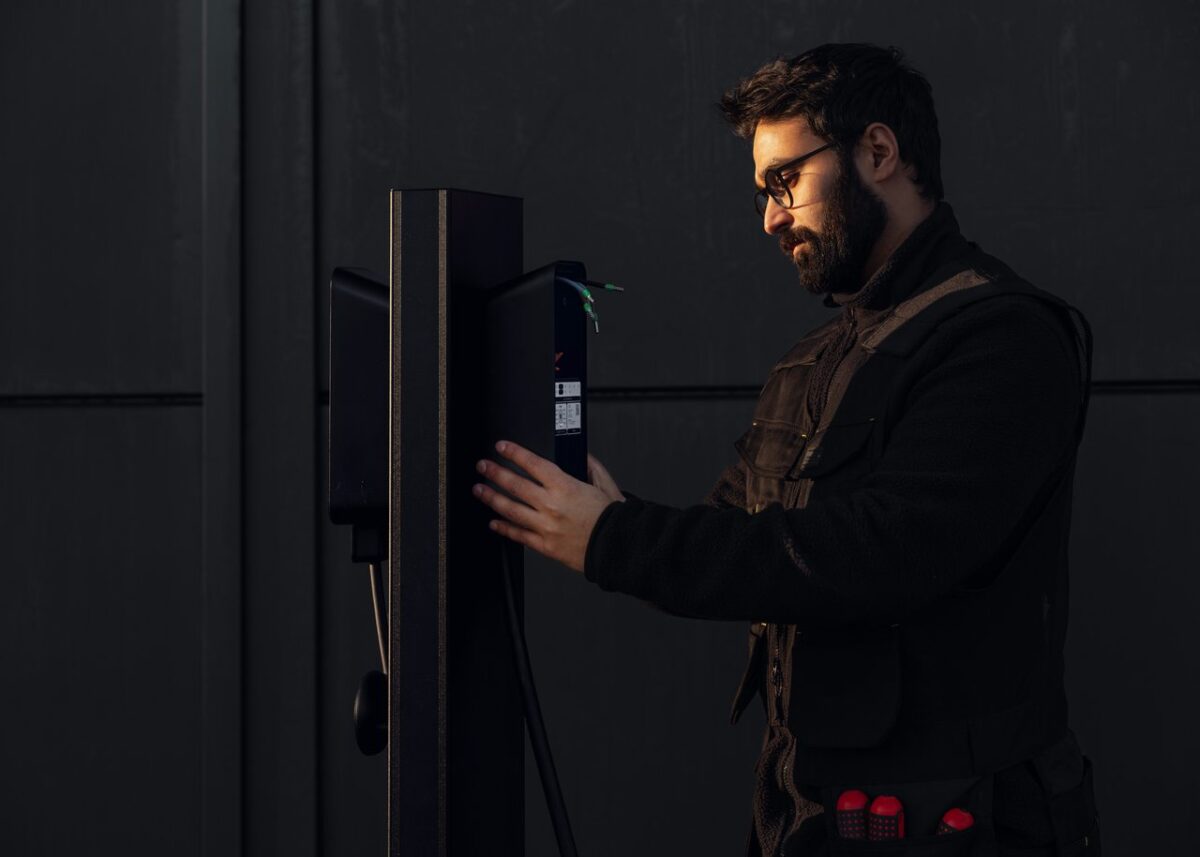
Do not fit it yourself. A good installer assesses your supply, chooses the safest connection point, handles the wiring and protective devices, and leaves you with paperwork confirming the job meets national standards, which matters for both your warranty and your insurance. When you are picking one, look for accreditation specific to EV charging, check they know your national wiring rules and any grant requirements, and get more than one quote.
What happens on the day
A straightforward install is a half-day job. The electrician inspects the consumer unit and plans the cable run, mounts the charger to a wall or post, connects it on its own circuit, then configures and tests it before handing over. Most of the time and cost comes down to how far the cable has to travel and whether the fuse box needs any work.

How much does it cost to install an EV charger?
Three things make up the total, and only one of them is known in advance.
The charger. This varies by model, power and features, from a simple home unit to a managed or metered one.
The installation. For a straightforward job, professional installation is commonly in the region of €300 to €600. Treat that as indicative: it moves with local labour rates and with how much work is actually involved.
Any electrical upgrade. This is the swing factor. A charger sited near a fuse box with spare capacity is cheap to fit. A long cable run, a full consumer unit, or a supply that needs upgrading can add a fair bit to the bill.
The only reliable number is a quote from a certified installer who has seen your setup. Before you get one, check your national scheme: several countries offer grants or tax relief for home charging, particularly for apartments and shared parking, and the terms change often, so your local energy authority is the place to confirm what is currently on offer.
Frequently asked questions
Can I install an EV charger myself?
No. It is fixed electrical work and must be carried out by a certified electrician to meet safety and legal requirements. In Norway this is mandatory, and most of Europe takes the same line.
How long does installation take?
For a professional, a straightforward home install is usually a half-day job. More involved work, such as a fuse-box upgrade or a long cable run, takes longer.
Can I just charge from a normal socket instead?
In an emergency, yes, but not as a daily routine. Household sockets are not built for hours at full load, and in Norway fitting a socket as a charging point is no longer permitted. Our guide to charging from a socket explains why.
Is it worth installing a home charger?
If you have somewhere to park and a supply to connect to, yes. It is the cheapest and most convenient way to run an electric car, and the charger will outlast the car you bought it for.
Related