Split Billing EV Charger Belgium: Everything You Need to Know (2026)
Belgium runs on company cars. Nearly nine in ten of the 145,000 electric vehicles sold in 2025 went onto a corporate fleet, not into a private driveway. That single fact shapes everything else about how the country charges. The car belongs to the employer. The electricity belongs to the employee. The reimbursement happens somewhere in between, and it is here that most of the friction lives.
From 1 January 2026, the framework around all of this changed. Fossil-fuel company cars ordered from that date lose their deductibility on a tightening schedule: 50% in 2026, 25% in 2027, zero from 2028. Battery electric vehicles purchased in 2026 keep their 100% deduction for the life of the contract. The CREG reimbursement tariff, which was meant to expire at the end of 2025, has been made permanent. And the federal home-charger tax credit, which some people are still asking about, has been gone since August 2024.
In short: more people than ever are charging a company car at home, the rules just settled into something stable, and the question of how to reimburse the electricity cleanly has become the practical bottleneck.
This is what split billing solves.

What is split billing for a company EV in Belgium?
Split billing is the system that separates the electricity used to charge a company car at home from the rest of the household’s consumption, and reimburses the employee accordingly. The employee pays their normal electricity bill. The charger records exactly how much energy went into the company vehicle. The employer reimburses that figure, usually monthly, at a rate that respects the CREG tariff cap.
Done properly, the reimbursement is not treated as additional taxable income. It sits outside the benefit-in-kind on the car itself. Done badly, it becomes a tax problem for both sides.
For this to work, three things are needed. A communicating charger that records every session with sufficient accuracy. A back office that can read those sessions, apply the right tariff, and produce defensible records. And an employer policy that reflects the CREG framework as it actually stands in 2026, not the version that was floating around two years ago.
Why does split billing matter more in 2026?
A few things shifted at once at the start of 2026.
Combustion-engine company cars ordered from 1 January 2026 enter the final phase of the taper: 50% deductible in 2026, dropping to 0% by 2028. Hybrids follow a similar phase-out. Battery electric cars purchased in 2026 stay 100% deductible for their full ownership lifetime. The maths for fleet managers stopped being subtle: the only commercially sensible new company car in Belgium right now is electric.
Most of those electric cars will charge at home. The driver does not want to detour to a public charger every other day, and the employer does not want to pay public-charging tariffs of €0.50–€0.79 per kWh when the same electrons at home cost a third of that.
So split billing stopped being a convenience and became core infrastructure. If you cannot reimburse home charging accurately, automatically, and at a tax-compliant rate, your company-car policy does not really work.
What is the CREG tariff, and is it still temporary?
The CREG (Commission de Régulation de l’Électricité et du Gaz / Commissie voor de Regulering van de Elektriciteit en het Gas) publishes a maximum per-kWh rate each quarter for the reimbursement of home charging on company cars. Stay at or below the rate, and the reimbursement is treated as a recovery of actual costs rather than a taxable benefit.
There is a common misunderstanding worth correcting here. The CREG system was introduced through circular 2024/C/77 as a temporary administrative tolerance, due to expire on 31 December 2025. A circular issued in June 2025 made the arrangement permanent. There is no longer an end date. Employers can rely on it.
Rates are based on the employee’s region of residence: Flanders, Wallonia, or Brussels-Capital. Each region gets its own quarterly maximum.
What are the CREG rates for 2026?
For the first quarter of 2026 (1 January to 31 March), the maximum reimbursable rates were:
- Flemish Region: €0.3132 per kWh
- Brussels-Capital Region: €0.3426 per kWh
- Walloon Region: €0.3523 per kWh
For the second quarter (1 April to 30 June 2026), the rates rose slightly:
- Flemish Region: €0.3191 per kWh
- Brussels-Capital Region: €0.3555 per kWh
- Walloon Region: €0.3637 per kWh
Rates change every three months. The Q3 figures are typically published in late June or early July. Any reimbursement above the applicable CREG rate is treated as additional taxable remuneration for the employee — handled separately from the company-car benefit in kind.
Read more about MID certified chargers

Does the amina M qualify for split billing in Belgium?
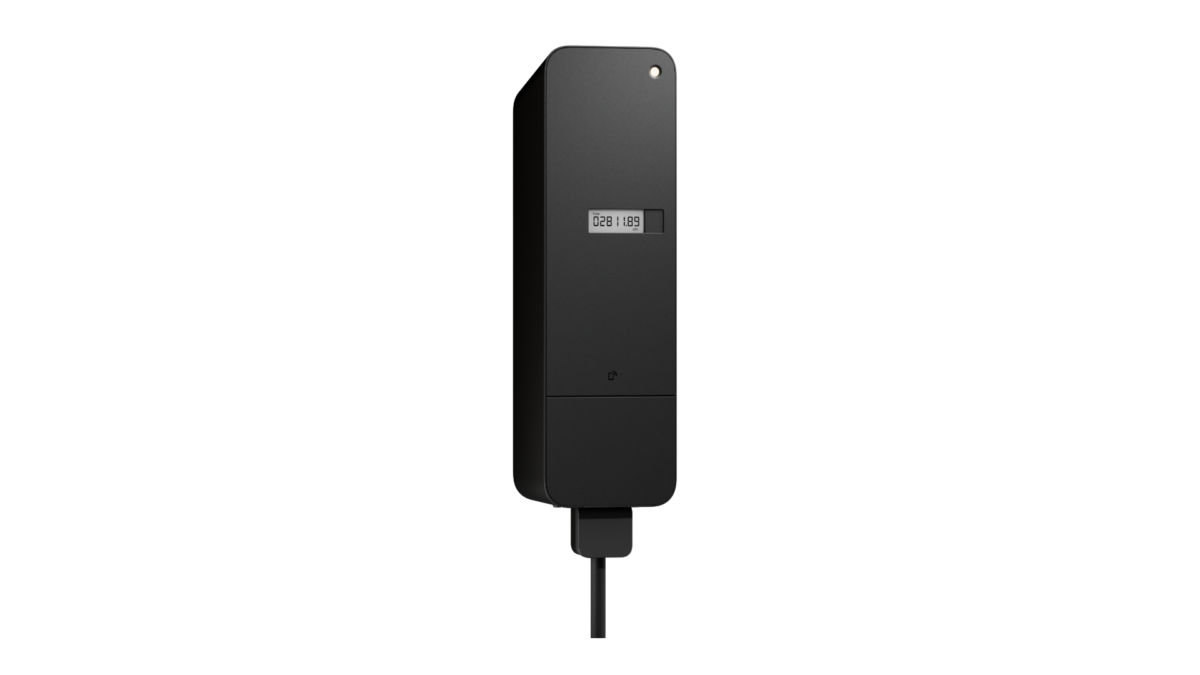
Yes. The amina M has a built-in MID-certified meter and reports every session over OCPP 1.6. That means the data going into the split-billing back office is legally valid for commercial reimbursement, and the integration works with any compliant CPO platform rather than a single proprietary cloud.
Why does an MID-certified meter matter for split billing?
MID stands for Measuring Instruments Directive — the European standard for energy-measurement accuracy. Under EU rules (Directive 2014/32/EU), measuring instruments used in commercial transactions where measurement determines the amount payable must be MID-compliant.
In practice for Belgian split billing, this matters because the FOD Financiën / SPF Finances requires MID-certified metering for the per-kWh reimbursement to be accepted as cost recovery rather than reclassified as taxable salary.
An external meter in the fuse box does not fix this for a company-car installation. The MID-certified meter has to be inside the charger itself, recording the session at the point of delivery. That is how the data closes the loop: charger reports kWh, back office applies the CREG tariff, employer reimburses, audit trail holds up.
The amina M ships with this built in as standard. It is not an option box.
How does split billing actually work, step by step?
The mechanics are the same across most Belgian providers, with minor differences in user interface and pricing.
- The employer signs a split-billing contract with a CPO or back-office provider (examples are listed below).
- A MID-certified, OCPP-compliant charger is installed at the employee’s home. Belgian electrical regulation (AREI / RGIE) applies, which means installation by a qualified electrician and an RCD configuration that handles DC fault currents — either a Type B RCD, or a Type A RCD combined with built-in DC fault detection in the charger. The amina M includes DC fault detection as standard, so a standard Type A 30 mA externally is sufficient in most installations. The qualified installer makes the final call based on the local situation.
- The charger reports each session over OCPP to the back office. Start time, end time, kWh, and the authorisation identifier are all logged.
- The employee authenticates each charging session, typically with an RFID card or via the back-office app. Sessions on the company vehicle are flagged; sessions on a private second car are not.
- The back office produces a monthly export. Employer pays the employee at or below the applicable regional CREG rate. The employee’s payslip or expense system handles the line.
- Tax records are retained. If the FOD ever asks, the chain is verifiable.
If the same household has a private EV that occasionally uses the same charger, the RFID authentication is what keeps the data clean. The charger can record both, but only the authenticated company-car sessions go into the reimbursement.
MID-certified EV charger, ready for split billing
What changed in 2026, and what is no longer valid?
This is the section most people want and almost nobody publishes clearly. A summary of the rules that genuinely changed and the older ones that no longer apply:
Still valid (and now permanent):
The CREG quarterly tariff for home-charging reimbursement, including the option for employers to apply the lowest of the three regional rates uniformly across all employees, provided the choice is applied consistently.
New from 1 January 2026:
Combustion-engine and plug-in hybrid company cars ordered from 1 January 2026 continue under the deductibility taper introduced in 2023: 50% in 2026, 25% in 2027, 0% from 2028 onwards.
BEVs ordered through 31 December 2026 stay 100% deductible for the full ownership period. From 2027, the deduction rate at the moment of purchase determines the lifetime rate: 95% for cars bought in 2027, then 90%, 82.5%, 75%, and finally 67.5% for cars purchased from 2031.
No longer valid:
The federal tax reduction for private individuals installing a home charger ended on 31 August 2024. It was originally a 2021–2024 scheme. Anyone still quoting it as a current incentive is working from outdated information. There are no replacement federal subsidies for private home chargers in 2026, although some regional and insurer-specific incentives remain.
Pending, not yet in force:
The federal mobility budget was originally scheduled to become mandatory on 1 January 2026 for all employers offering company cars. The legislative texts were not adopted in time. As of early 2026, the expected timeline is 1 January 2027 for companies with 50+ employees on company-car schemes, and 1 January 2028 for 15+. From 1 January 2026, pillar 1 (eco-friendly company car) requires fully electric vehicles, and motorised shared-mobility options in pillar 2 (shared cars, ride-hailing, longer car hire) must also be zero-emission. Soft mobility options like bikes and electric scooters are governed separately.
Split billing is, technically speaking, the reimbursement of electricity per kWh.
What about plug-in hybrids?
For employer-purchased plug-in hybrids ordered from 1 January 2026, deductibility under corporate income tax is gone. There is a narrow exception for self-employed individuals declaring actual professional expenses, who can still claim 75% deductibility on hybrids ordered in 2026. Fossil-fuel costs for these vehicles remain capped at 50% deductibility; electricity costs follow the vehicle’s rate.
For PHEVs ordered before 1 July 2023, the older deductibility rules continue for the lifetime of the vehicle.
Electricity costs reimbursed for PHEV charging at home follow the same CREG framework as full BEVs, capped at the same rates.
Who is responsible for what: employer, employee, or landlord?
The cleanest answer comes from looking at the three layers:
The charger hardware. Usually purchased by the employer or included in the leasing contract. Belongs to the employer in most setups. Some agreements transfer ownership to the employee at end of lease, others do not. Worth being explicit in the car policy.
The electricity. The household contract is the employee’s. The employer reimburses the metered consumption that went into the company car.
The installation. The employee gives access to the property. The employer pays for the installation and the AREI / RGIE inspection. In a rented home, the landlord’s written permission is normally required for any wall-mounted hardware. Some employers have a standard landlord-consent form in the onboarding pack.
If the employee leaves the company while the charger is still on their wall, the contract usually provides for either removal, transfer of ownership at residual value, or continued operation under a private back-office subscription. Worth checking the small print before signing.
Can the employer choose one CREG rate for the whole fleet?
Yes, but with a caveat. The default is to apply the CREG rate of the region where each employee lives. The alternative is to apply the lowest of the three regional rates uniformly for all employees, for the full calendar year. In Q1 2026 the lowest was Flanders at €0.3132 per kWh. The lowest-region option simplifies administration but disadvantages Walloon and Brussels-based employees, who could have been reimbursed at a higher rate.
Some employers, particularly smaller ones, apply the lowest of the three regional rates uniformly across all employees as an administrative simplification. The FOD expects the chosen method to be applied consistently rather than switched session by session, so most employers fix it at the start of the calendar year.
What if the employee moves house mid-year?
The applicable CREG rate is based on the employee’s place of residence at the time of charging. If an employee moves from Antwerp to Liège in June, sessions before the move use the Flemish rate, sessions afterwards use the Walloon rate. The back office handles this automatically if the address is updated. If it is not updated, expect a difficult conversation with payroll later.
What if two people in the same household both have company EVs?
This is increasingly common in Belgium, given how dominant company-car schemes are. The technical answer is that each company car needs its own authentication identifier (typically a separate RFID card) on the charger. The charger records each session against the correct vehicle, and the back office routes the reimbursement to the correct employer.
Practically speaking, this works without trouble on a single charger if both employers are willing to use the same CPO platform. If the two employers insist on different back-office providers, the simplest fix is a second charger. Less elegant, but cleaner administratively.
How does split billing interact with the federal mobility budget?
If an employee converts their company-car entitlement into the mobility budget, they typically lose the company-paid home charger as well. The mobility budget can, in principle, be used to lease a smaller fully electric car under pillar 1, in which case the split-billing setup continues. Or it can fund alternative mobility under pillar 2, in which case there is nothing left to reimburse via split billing.
The interaction matters most for employees switching mid-contract. Worth flagging in the car policy that mobility budget conversion will involve disconnecting the existing home charger from the company’s back office.
Where to buy and install an amina M in Belgium
Our partners in Belgium handle hardware, installation, and the back office on the split-billing side.
Blulinc operates the back-office platform, app, and charging-card network for both employer and employee. They handle CPO-side billing, public-charging access, and the integration with payroll for reimbursement. Suitable for fleet operators looking for a single-vendor split-billing solution.
Scoptvision provides smart-charging control software that sits as a layer between the hardware and the CPO platform, with native support for OCPP-compliant chargers including the amina M. Particularly relevant where dynamic load management and grid-aware charging are part of the requirement (commercial parking, multi-unit residential with shared connection).
Both can supply, install, and operate the amina M under a split-billing arrangement.
Want to know more about the amina M?
The amina M is a single- and three-phase AC charger built for demanding environments, including company-car home installations, multi-unit residential blocks, fleet depots, and commercial premises. Manufactured in Norway, IP54-rated, with a built-in MID-certified meter and full OCPP 1.6 support.
Related